
What is MLS in Real Estate? The Complete Guide to Multiple Listing Service (2026)
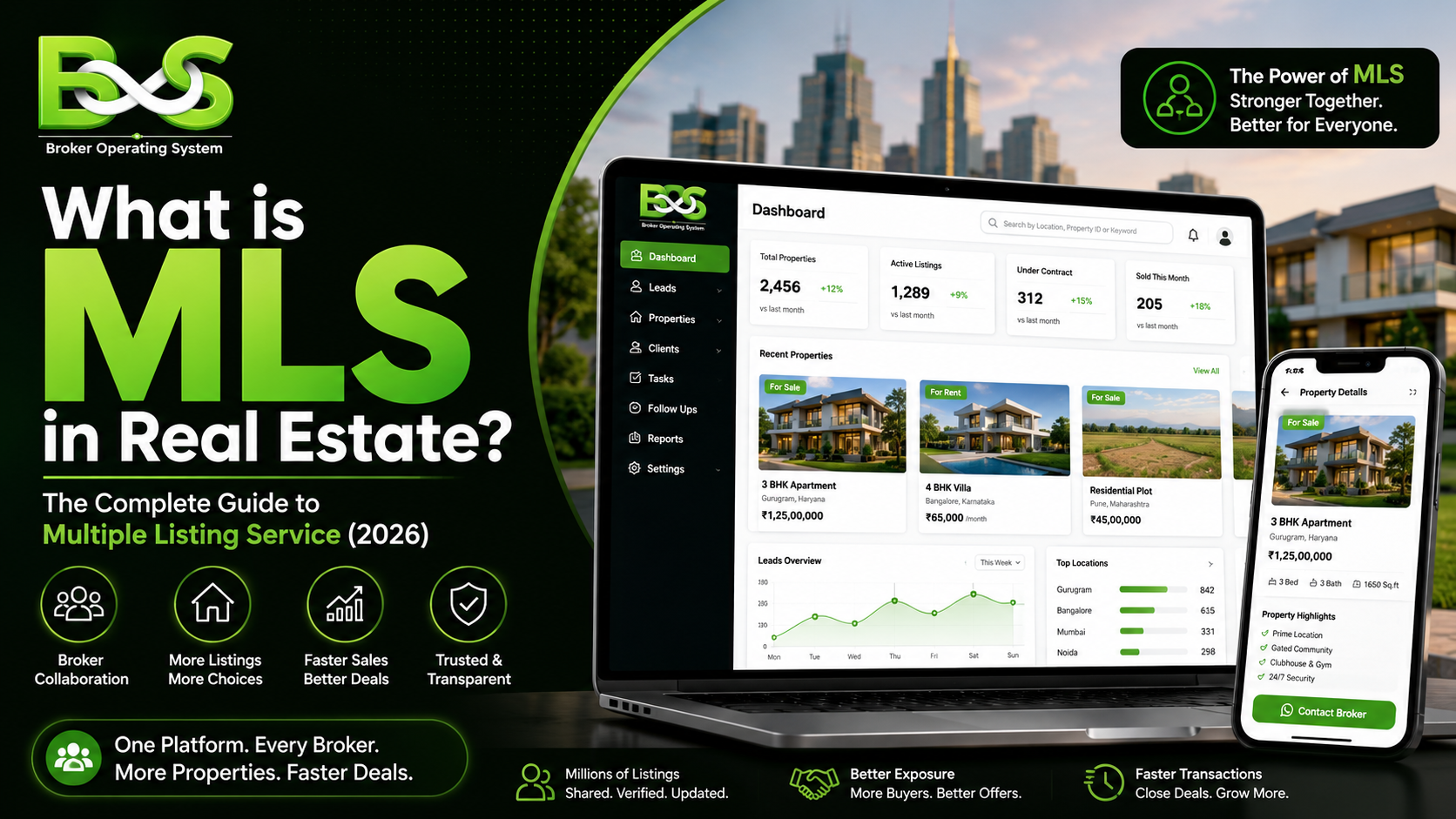
For decades, the Multiple Listing Service (MLS) has been the backbone of real estate transactions in countries like the United States and Canada. It enables brokers to collaborate, share property listings, and close deals faster.
Yet, despite being one of the largest real estate markets in the world, India still lacks a unified MLS system.
This raises an important question: What exactly is an MLS in real estate, and why does it matter?
Whether you're a broker, agency owner, investor, or someone buying a home, understanding MLS can completely change how you think about property transactions.
In this guide, you'll learn:
What is MLS in Real Estate?
MLS (Multiple Listing Service) is a centralized database where licensed real estate brokers list properties available for sale or rent.
Rather than keeping listings private, brokers share them with other verified brokers through a common platform.
This creates a collaborative marketplace where:
- Brokers access thousands of verified listings
- Buyers receive more property choices
- Sellers gain wider market exposure
- Transactions happen much faster
"Think of MLS as Google for professional real estate brokers—but only verified professionals can add or edit listings."
What Does MLS Stand For?
MLS stands for Multiple Listing Service.
Despite its name, MLS isn't a single global organization. Instead, it refers to regional databases operated by real estate associations.
For example:
- California Regional MLS
- Bright MLS
- Stellar MLS
- Midwest Real Estate Data
Together, these MLS platforms contain millions of active property listings and process billions of dollars in annual property transactions.
How Does MLS Work?
The MLS process is surprisingly simple.
Step 1: Property Listing
A homeowner hires a licensed broker. The broker gathers:
- Property details
- Photos
- Floor plans
- Pricing
- Amenities
- Legal documentation
The property is uploaded into the MLS database.
Step 2: Broker Collaboration
Every registered broker connected to the MLS can now view the listing. If another broker has a buyer interested in that property, they arrange a showing.
Step 3: Commission Sharing
If the property is sold through another broker, both brokers share the commission based on predefined rules. This creates an incentive for collaboration rather than competition.
Step 4: Sale Completion
The transaction closes. The property status changes from Active to Under Contract or Sold, keeping market data accurate.
Why Was MLS Created?
Before MLS systems existed, brokers worked independently. Problems included:
- Duplicate listings
- Hidden inventory
- Slow sales
- Poor cooperation
- Buyers missing suitable properties
MLS solved these challenges by creating one trusted database for everyone. Today, MLS is considered one of the biggest innovations in modern real estate.
Benefits of MLS for Real Estate Brokers
- Access to More Properties
Instead of marketing only their own listings, brokers gain access to thousands of additional properties. This dramatically increases the likelihood of finding the right property for clients.
- Faster Property Sales
Because listings are visible to every participating broker, properties receive significantly more exposure. More visibility leads to faster transactions.
- Higher Closing Rates
MLS helps brokers match buyers with suitable properties quickly, increasing conversion rates.
- Reliable Market Data
MLS platforms provide valuable information such as selling prices, days on market, price changes, property history, and comparable sales (Comps). This enables more accurate pricing and stronger client advice.
- Professional Networking
MLS fosters collaboration among brokers rather than forcing them to work in isolation. This builds trust across the industry.
Benefits of MLS for Buyers
Homebuyers also benefit significantly from MLS:
- Wider Choice: Instead of seeing listings from one broker, buyers gain access to nearly the entire market.
- Accurate Information: MLS data is updated frequently, reducing outdated or misleading listings.
- Faster Search: Advanced filters allow buyers to search based on budget, bedrooms, locality, amenities, plot size, builder, and possession status.
- Better Transparency: Property history and price changes help buyers make informed decisions.
Benefits of MLS for Sellers
For sellers, MLS dramatically increases visibility. Advantages include:
- More buyers viewing the property
- More brokers marketing the property
- Faster offers
- Better selling price through increased competition
- Reduced marketing effort
Instead of depending on one broker's network, sellers leverage the reach of an entire brokerage ecosystem.
Why MLS is So Successful in the United States
The United States has one of the world's most mature MLS ecosystems. Key reasons include:
- Standardized listing formats
- Strict verification processes
- Mandatory data accuracy
- Broker cooperation rules
- Shared commissions
- Integration with major real estate portals
This has helped create one of the most transparent property markets globally.
Does India Have an MLS?
The short answer is: Not a nationwide standardized MLS.
India has several property portals where owners, brokers, and builders can post listings, but these are not true MLS platforms. Unlike MLS systems:
- Listings are often duplicated.
- Property information can become outdated.
- Brokers rarely collaborate through a shared database.
- Commission sharing lacks standardization.
- Inventory remains fragmented.
As a result, brokers spend significant time maintaining separate spreadsheets, WhatsApp groups, and disconnected listing records instead of focusing on clients and transactions.
Challenges Without an MLS in India
The absence of a standardized MLS creates several operational challenges:
- Duplicate Listings: The same property is frequently advertised by multiple brokers with varying details, leading to confusion and inefficiency.
- Outdated Inventory: Properties that have already been sold or rented often remain visible for weeks or months.
- Limited Broker Collaboration: Without a trusted shared platform, brokers tend to work independently, reducing opportunities to match buyers with the right inventory.
- Time-Consuming Manual Processes: Many agencies still rely on spreadsheets, WhatsApp chats, and handwritten notes to manage listings and follow-ups.
- Reduced Market Transparency: Inconsistent pricing and incomplete property histories make it harder for buyers and sellers to make informed decisions.
What Makes a Modern MLS Different?
Today's MLS platforms are far more advanced than simple listing databases. A modern system typically includes:
- AI-powered property matching
- Smart search filters
- Integrated customer relationship management (CRM)
- Automated lead management
- Mobile accessibility
- Real-time listing updates
- Digital document storage
- Analytics and reporting dashboards
- Broker collaboration tools
- API integrations with property portals and marketing platforms
The Future of MLS
Real estate technology is evolving rapidly. Future-ready MLS platforms are expected to incorporate:
- Artificial intelligence for personalized property recommendations
- Predictive analytics for pricing trends
- Virtual property tours
- Digital contracts and e-signatures
- Blockchain-backed transaction records
- Automated commission calculations
- Integration with WhatsApp, email, and communication tools
Rather than serving as just a listing repository, the next generation of MLS platforms will function as comprehensive operating systems for real estate businesses.
Why MLS Matters More Than Ever
Today's buyers expect speed, transparency, and accurate information. Sellers want maximum exposure. Brokers need efficient collaboration and reliable data.
An effective MLS aligns these interests by creating a shared, standardized ecosystem where verified professionals can work together, reduce duplication, and complete transactions more efficiently.
For emerging markets such as India, the adoption of structured MLS practices represents an opportunity to modernize brokerage operations, improve market transparency, and deliver a better overall experience for buyers, sellers, and real estate professionals.
Conclusion
The Multiple Listing Service (MLS) has transformed how real estate professionals collaborate across many mature markets. By centralizing listings, standardizing information, and encouraging cooperation, it benefits brokers, buyers, and sellers alike.
As India's real estate sector continues to digitize, the principles behind MLS—shared inventory, verified data, and seamless collaboration—are becoming increasingly relevant. Organizations that embrace these practices early will be better positioned to serve clients efficiently and compete in a technology-driven market.
Whether you're an independent broker, a growing agency, or a real estate entrepreneur, understanding how MLS works is an important step toward building a more productive and transparent business.